

How YouTube Automation Actually Works Step by Step (2026): The Honest Guide
“YouTube automation” is one of the most misunderstood phrases in the online business world. Course sellers use it to mean passive income on autopilot. Skeptics use it to mean spam. Neither is right.
The real definition is far simpler: YouTube automation is the practice of systematizing a channel’s production so every video follows a repeatable workflow — scripting, voiceover, editing, thumbnails, uploads — instead of depending on one person’s free time. A team or set of tools handles production while a real human directs strategy and quality.
Here’s what that workflow actually looks like, step by step — what an honest agency does at each stage, what sellers tend to leave out, and where the process breaks down.

Step 1: Niche Selection
Every automated channel starts with a niche decision, because the niche determines everything downstream: the content supply, the competition level, and the advertising rates that niche commands. Finance niches historically pay higher ad rates than entertainment; documentary niches offer deep topic libraries but slower growth.
What an honest agency does here: recommends against oversaturated niches, checks whether there are enough fresh topics to sustain months of uploads, and explains the trade-offs plainly. Some channels grow fast but earn modestly per view; others grow slowly but monetize well.
What sellers often hide: the “secret high-CPM niche” pitch. The highest-paying niches are also the most competitive and the most heavily scrutinized by YouTube’s policies. And a niche has to match the production capacity you can sustain for a year or more.
Step 2: Research and Content Planning
Next comes the content calendar — a list of specific video topics planned weeks or months ahead, built by studying what’s already performing in the niche, finding gaps, and choosing angles that haven’t been done to death.
What an honest agency does here: studies competitor channels, trending topics, and search demand before locking in topics — and kills weak ideas early instead of producing them anyway.
What sellers often hide: content planning is where most automated channels quietly die. Agencies that skip this step produce videos on stale or duplicated topics, publish them on schedule, and blame “the algorithm” when nothing performs. A channel without research is just expensive noise.
Step 3: Scriptwriting
The script is the skeleton of every faceless video. Written by a human, an AI tool, or both, a good script has a hook in the first 30 seconds, a clear structure, and enough substance to justify the runtime.
What an honest agency does here: writes scripts specific to each video — with original framing, fact-checking, and a human review pass before anything is recorded.
What sellers often hide: this is the step cheap operations butcher first. When one template gets recycled across hundreds of videos with only the topic swapped, YouTube sees it — and this is exactly what runs into YouTube’s “inauthentic content” policy. More on that in the monetization section.
Step 4: Voiceover
Every script needs a voice. Channels use professional human voiceover artists or AI text-to-speech voices — both are allowed on YouTube. What matters isn’t who or what reads the script; it’s whether the result sounds natural and fits the channel’s style.
What an honest agency does here: picks one consistent voice per channel and checks pronunciation and pacing in the review pass — flat, robotic narration kills retention.
What sellers often hide: voice quality is a retention lever. Some sellers promise “real human voiceover” in the pitch and deliver low-effort AI audio in production. If the voice matters to you, ask to approve it before production starts.
Step 5: Video Editing and Visuals
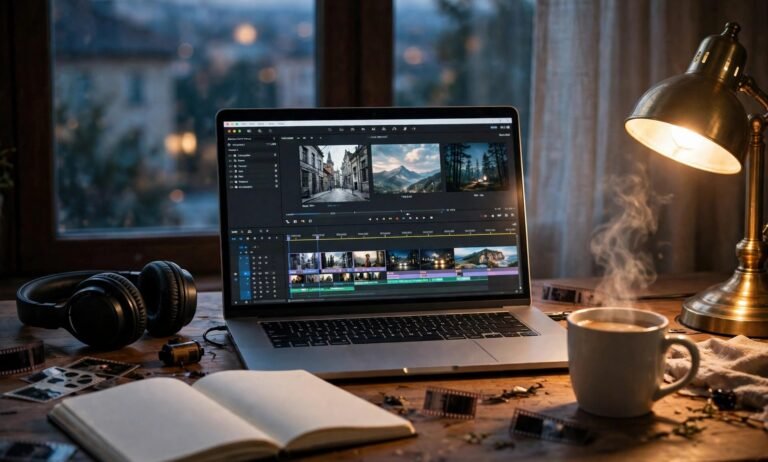
This is where script, voiceover, stock footage, animations, graphics, and music get assembled into a finished video.
What an honest agency does here: builds each video around the script’s story rather than slapping the same visual template over every upload. Original graphics, deliberate pacing, footage that actually illustrates the narration.
What sellers often hide: editing is where the largest quality gap lives between a $40 video and a professional one. If every video on a channel looks interchangeable, the channel is living on borrowed time — YouTube’s policies target exactly that.
Step 6: Thumbnail Design
The thumbnail is the channel’s billboard. Viewers decide whether to click in a fraction of a second, and click-through rate (CTR) data feeds directly into how widely YouTube distributes a video.
What an honest agency does here: designs a distinct thumbnail per video with readable text, clear focal points, and a consistent channel style — then iterates based on CTR data.
What sellers often hide: thumbnails can’t save a bad video. A great thumbnail on weak content gets clicks followed by instant exits — which tells YouTube the video isn’t satisfying, and distribution drops.
Step 7: SEO, Upload, and Scheduling
Before a video goes live it needs a title, description, tags, end screens, and a publishing schedule — keyword research applied to titles, descriptions that explain the video honestly, and consistent upload timing.
What an honest agency does here: uses real keyword research, matches metadata to the video’s actual content, and publishes on schedule.
What sellers often hide: “SEO optimization” is one of the most abused phrases in this industry. Keyword-stuffed titles and misleading metadata might squeeze extra impressions, but they erode trust with viewers and with YouTube. No SEO trick compensates for a video people don’t finish watching.
Step 8: Channel Management and Analytics
After publishing, the work continues: reading analytics (retention curves, CTR, traffic sources), responding to comments, and adjusting the content plan based on what the data says.
What an honest agency does here: reviews performance regularly, doubles down on formats that work, retires formats that don’t, and reports clearly. Channel management is ongoing strategy, not a set-and-forget dashboard.
What sellers often hide: this step is where “fully automated” claims fall apart. A channel with nobody reading the analytics is flying blind. If an agency’s pitch skips regular review and strategy adjustments, you’re buying production, not management — and you should pay production prices for it.
Step 9: Monetization — The Honest Reality
To earn ad revenue, a channel must join the YouTube Partner Program (YPP): roughly speaking, 1,000 subscribers plus 4,000 hours of watch time in the last year, or 10 million Shorts views in 90 days. Hitting those thresholds gets your channel reviewed — not automatically approved. Reviewers assess the channel as a whole: its theme, top videos, metadata, and whether the content is genuinely original.
The policy that matters most here: in mid-2025, YouTube renamed its “repetitious content” rule to “inauthentic content”, making clear that mass-produced, template-identical videos — AI-assisted or not — don’t qualify for monetization. YouTube framed it as a clarification: this content was always ineligible. AI tools and outsourcing are fine; what isn’t fine is a channel where videos feel interchangeable and no original creative work went into them. Realistic AI-generated content that viewers could mistake for real people or events must also be disclosed.
What an honest agency does here: builds every video to pass a human review — original scripts, original editing, disclosure where required — and tells you plainly that approval is YouTube’s decision, never a promise.
What sellers often hide: no agency can guarantee monetization approval or any income timeline.
Where the Process Breaks Down
If you want one summary of every failure mode in YouTube automation, it’s this: the workflow works when a real human directs it, and it breaks when “automation” means nobody’s home. The most common breakdowns:
- Template decay: the first 20 videos look fine; by video 60, every upload is a reskinned copy. Policy risk and viewer boredom compound together.
- Script quality collapse: writers get cut first, because it’s the easiest place to hide a cut — until the videos sound interchangeable.
- No strategy loop: videos publish on schedule but nobody reads the analytics, so failing formats repeat for months.
- Vanishing support: the agency stops responding once the contract is paid. Ownership, access, and file handover must be settled in writing before you pay anything.
All four are preventable — and all four are common. That gap between what’s promised and what’s managed is the real story of this industry.
What an Honest Agency Does Differently
A legitimate operation looks like this:
- Original work at every step — not templates with swapped topics.
- A human reviews every video before it ships.
- Strategy adjusts based on analytics, not on autopilot.
- You own the channel, the files, and the access credentials.
- Honest answers about timelines, costs, and risks — in writing.
That’s the standard we hold ourselves to at Xoomo YouTube Automation. Our done-for-you faceless YouTube channel service runs the full workflow above with a dedicated team at each stage, our packages are priced per video with no hidden fees, and our contact page is where every engagement starts with an honest conversation — including telling you when your niche isn’t a fit. (Client channel — identity protected under NDA.)
Frequently Asked Questions
Is YouTube automation actually legal?
Yes. YouTube has no rule against outsourcing production or using AI tools, and no requirement to appear on camera. The rules target the output — inauthentic, mass-produced, or reused content — not the production method.
How long does it take for an automated channel to get monetized?
It depends on the niche, upload consistency, and viewer retention — typically months of steady publishing before the thresholds are in reach, then a review on YouTube’s own timeline. Anyone quoting a specific week or month is guessing or selling.
Can AI voiceovers and AI-written scripts pass YouTube’s review?
Yes, if the content is original and a human exercised real creative judgment over it. What gets rejected is mass-produced, template-identical output with no original perspective — regardless of the tools used.
What’s the biggest risk in YouTube automation?
Channels whose videos look interchangeable risk having monetization denied or removed channel-wide. The second-biggest risk is operational: paying an agency that stops managing the channel after the contract is signed.
Do I own my channel if an agency builds it for me?
You should — and this must be in writing before you pay. You should hold the account ownership, have full admin access to the channel, and receive all original project files. If an agency hesitates on any of that, walk away.
Is “passive income” from YouTube automation real?
The passive part is the viewing: published videos can earn while you sleep. The building part is not passive — it takes months of consistent production, quality control, and strategy. Treat “autopilot income” sellers with the skepticism they deserve.
Want this workflow run properly on your channel?





4 Comments