

Faceless Travel Channel Videos (2026): Production Guide
A faceless travel channel sounds like the easiest niche in the world. Grab some drone footage, add a voiceover, and watch the views roll in. That’s the fantasy guru thumbnails sell.
Here’s the honest version from the team at Xoomo YouTube Automation: travel is one of the most forgiving niches on YouTube if you produce it properly — and one of the most punished if you cut corners. The difference comes down to production quality, licensing discipline, and whether your videos offer anything ten identical channels don’t.

Why Travel Works Faceless (And Why It’s Harder Than It Looks)
Travel has a natural advantage over almost every other faceless niche: the destination is the star. Nobody opens a city guide hoping to see the creator’s face — they want the streets of Lisbon, the night markets of Bangkok, the Amalfi Coast. Destination-guide channels pull hundreds of thousands of views without a host on screen.
The demand side is real: travelers use YouTube as a trip-planning tool — itineraries, hotel walkthroughs, budget breakdowns. A good “where to stay in Paris” video earns views for years; that evergreen search demand is the niche’s biggest asset.
Why is it harder than it looks? Three reasons. First, footage is the entire product. Grainy, mismatched, or repetitive clips kill a travel video fast. Second, you compete with people who actually travel. You can’t win on authenticity of footage, so you must win on information density and production polish. Third, travel is policy-sensitive for lazy production. YouTube’s 2025 “inauthentic content” update targets exactly the channels that string stock clips together with a robotic voiceover and no original contribution.
Faceless Travel Formats That Actually Work
Not all travel formats are equal. Here’s how the main ones compare:
| Format | Competition | Why It Works Faceless |
|---|---|---|
| City guides & itineraries | High | Evergreen search; depth beats volume |
| Virtual walking tours | Medium | Huge watch times; walk is the content |
| Luxury travel | Medium | Aspirational; premium advertisers, affiliates |
| Budget travel | High | Proven format; specificity wins |
| Travel documentaries | Lower | Deep scripts are hard to copy |
| Animated route maps | Lower | Original graphics = transformative |
| Travel tips & hacks | Very high | Only fresh angles survive |
My honest take: pick one lane and go deep — a channel doing luxury hotel breakdowns every week builds a brand; a channel mixing walking tours and budget hacks is noise. If the premium end appeals to you, our faceless luxury channel service covers how that side of the niche works.
What Real Travel Production Actually Involves
A proper faceless travel video goes through the same pipeline as any documentary. Short version of each step:
1. Research and angle
“Paris travel guide” is not an angle — it’s a keyword no newcomer can win. “The 6 Paris neighborhoods worth your time (and 3 to skip)” is an angle. This is the step cheap production skips, and it’s effectively the first thing YouTube reviewers check.
2. Scripting
An 8-minute travel video needs roughly 1,000–1,200 words of narration paced with the visuals. Generic AI scripts read like Wikipedia; good ones read like a well-traveled friend.
3. Voiceover
For faceless travel, the voice IS the host. Flat robotic narration tanks retention; a warm, well-paced voice holds viewers through eight minutes of scenery. Keep the same voice across videos — it becomes the channel’s identity.
4. Footage sourcing and editing
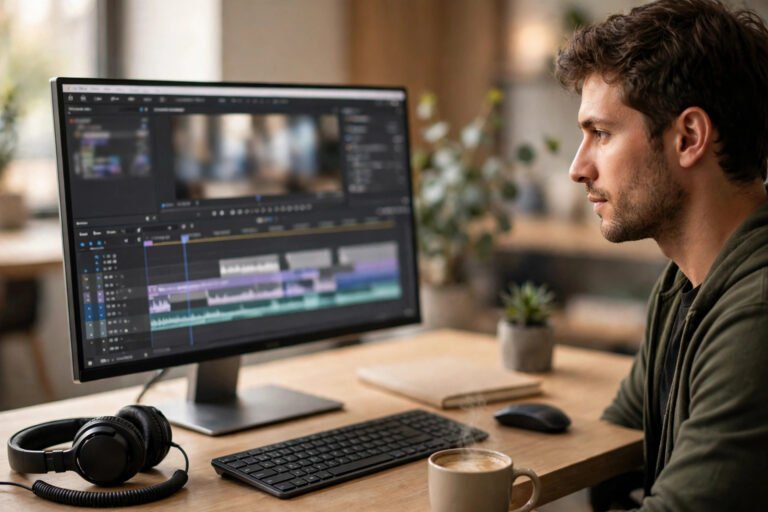
This is where travel production lives or dies: licensed footage matched to the script beat by beat, cinematic pacing, consistent color grading, and motion graphics, maps, and text overlays for facts and costs.
5. Sound design and music
Travel videos live in their atmosphere. Royalty-free music must be genuinely cleared — Content ID claims on music are one of the most common revenue leaks in the niche.
6. Thumbnails, SEO, and publishing
One mini design project per thumbnail: the destination, one bold element, readable at phone size. Keyword-targeted titles, timestamped descriptions, real search terms as tags — then consistent scheduling.
Footage Licensing and YouTube’s Rules — The Honest Version
Free stock footage is legal in monetized videos — Pexels, Pixabay, and Mixkit allow commercial use with no attribution. The catches:
- You can’t resell clips unchanged — they must become part of a larger work, which your edited video qualifies as.
- You can’t register stock clips in Content ID — you don’t own them.
- Recognizable people, brands, and trademarks need releases. A drone shot over a branded hotel’s rooftop pool can create real problems.
- Some “free” results are sponsored. Paid-library ads sit above the free results on some platforms — downloading those without a license is infringement with extra steps.
- Legal doesn’t mean safe for monetization. Thousands of channels can legally use the same clip; the risk is YouTube’s inauthentic content policy. If your videos look interchangeable with everyone else’s, reviewers can remove the whole channel from the Partner Program.
On July 15, 2025, YouTube renamed its “repetitious content” policy to “inauthentic content” in the Partner Program guidelines — framed as a clarification, not a new rule. What stays monetized: original scripts, real narration that adds commentary, and editing that transforms the footage. What gets hit: image slideshows with unedited text-to-speech, and near-identical videos differing only by the topic word. Original scripts + consistent voiceover + genuine editing = safe. Same template over the same stock clips = the exact profile YouTube enforces against.

DIY vs. a Done-for-You Team
You can build a faceless travel channel yourself — but should you?
| DIY | Done-for-You Team | |
|---|---|---|
| Time per video | 10–20+ hours | Near zero — you approve the plan and the finals |
| Quality ceiling | Your editing skill and footage budget | Pro editors, consistent voiceover, designed thumbnails |
| Consistency | Most DIY channels stall at 5–8 videos | Weekly publishing on a real schedule |
| Licensing risk | On you | Handled in the workflow |
| Policy risk | High if you template to save time | Lower when each video is originally produced |
| Best for | Hobbyists who enjoy editing | Founders treating the channel as a business |
One honest note: most cheap freelancers sell editing, not a channel. A real done-for-you service — like Xoomo YouTube Automation’s done-for-you faceless YouTube channel package — covers research, script, voiceover, edit, thumbnail, and publishing as one system, with channel management if you need it.
What Faceless Travel Videos Cost in 2026
Observed ranges, not made-up numbers. Solo editors list travel videos at $15–$90 per video — usually edit-only, with you supplying the script and voiceover. At the other end, published agency pricing runs from a few hundred dollars a month for AI-assisted tools up to around $5,000 a month for high-touch retainers.
Our own pricing is public and fixed — no quote needed:
| Package | Videos | Price |
|---|---|---|
| Starter | 5 videos | $390 |
| Growth | 10 videos | $790 |
| Accelerator | 12 videos | $890 |
| Authority | 15 videos | $1,099 |
| Empire | 20 videos | $1,499 |
| Dominance | 25 videos | $1,899 |
Every package is long-form: each video is 8 minutes and includes thumbnail, SEO, and channel management. The monthly plan is 25 long videos + 10 Shorts — full breakdown on our packages page. We won’t promise view counts, revenue, or timelines. Any provider who guarantees those is selling a fantasy — results depend on sub-niche, competition, and consistency over months.
Red Flags When Hiring a Travel-Video Team
- No mention of licensing. If they can’t name their footage sources and licenses, walk away.
- “100 videos a month” promises. That volume requires templated output — exactly what YouTube’s inauthentic content policy targets.
- Slideshow samples. Static images over text-to-speech is not a portfolio; it’s a warning.
- Guaranteed views or income. Nobody can guarantee YouTube performance. Guarantees are a sales tactic.
- No script samples. The script is half the video. If they won’t show one, they don’t write them.
- No describable workflow. Research, script, voice, edit, thumbnail, SEO — if they can’t list the steps, there is no workflow.
Is a Faceless Travel Channel Right for You?
Travel rewards a specific kind of owner. It’s a good fit if you enjoy research and storytelling, you can publish consistently for at least six months, and you treat the channel as a media asset, not a lottery ticket. Travel videos are evergreen — today’s video can still earn views in three years. It’s a bad fit if you want fast results or the cheapest possible production: cheap travel content is the most policy-punished category on the platform. One well-produced channel beats five template mills, every time.
If you’re serious about building one the right way, Xoomo YouTube Automation already runs this pipeline — Client channel — identity protected under NDA. If you’d rather assemble your own crew, our hire a faceless YouTube team page explains how. Either way, start on our contact page and tell us your niche.
Frequently Asked Questions
Can a faceless travel channel get monetized in 2026?
Yes — faceless isn’t the problem, mass production is. YouTube’s policy framing confirms original scripts, real narration, and transformative editing qualify for the Partner Program. Produce each video like an original documentary and you’re on solid ground.
Do I need to travel to run a travel channel?
No. Faceless travel channels are built on licensed stock and drone footage combined with original scripts and voiceover. The honest trade-off: you’ll never have exclusive footage of a place, so your script, pacing, and editing have to beat the channels that do.
Is free stock footage legal for monetized YouTube videos?
Yes, under the licenses of the major free libraries — Pexels, Pixabay, and Mixkit all allow commercial use without attribution. Don’t resell clips unchanged, don’t register them in Content ID, and clear anything showing recognizable people, brands, or trademarks. Remember: legal doesn’t automatically mean monetizable if every channel uses the same clips.
How much does a faceless travel video cost to produce?
Solo freelancers list travel videos around $15–$90 per video on marketplaces, but those are usually edit-only. Full production (research, script, voiceover, licensed footage, edit, thumbnail, SEO) from an agency costs more; our packages start at $390 for 5 long-form videos with everything included. Full production for a few dollars a video means templating — a policy risk.
What’s the best faceless travel sub-niche for a new channel?
The best effort-to-opportunity ratio right now: travel documentaries, luxury travel, animated route-map videos, and long-form walking tours — harder to produce, so fewer lazy competitors. Generic “travel tips” listicles are the most crowded and easiest to copy. Pick one lane and commit; identity beats format hopping.
How long does it take a faceless travel channel to grow?
No honest number exists — it depends on sub-niche, competition, consistency, and quality. Travel content is evergreen, so early videos keep working while you publish new ones; channels publishing weekly for six to twelve months give themselves a real shot. Anyone promising results in 30 days is selling, not building.


2 Comments