Faceless Aviation Channel Videos Service (2026): The Honest Production & Service Guide
Aviation has one of the most loyal audiences on YouTube. Plane lovers follow a channel for years, and they can tell in ten seconds whether a narrator knows the subject or just read a page out loud. That is why a faceless aviation channel can work so well, and why it can fail so fast if the production is sloppy.
A faceless aviation channel videos service builds that kind of channel for you without putting anyone on camera: research, script, voiceover, flight-path maps, licensed footage, edit, thumbnail, and upload. At Xoomo YouTube Automation, we build channels like this for owners in the USA, UK, Canada, Australia, and the Netherlands. This guide explains what the service covers, which formats hold an audience, where the line sits on accuracy and respect, and how our production runs from topic pick to published video.
What a faceless aviation channel actually is
A faceless aviation channel is a YouTube channel about flying that never relies on a host in front of a camera. Each video uses narration over original graphics, flight-path maps, diagrams, animation, and licensed stock visuals. The script does the heavy lifting: a good one answers a real question, like why a plane leaves white trails behind it, or what happens inside a control tower.
That matters more here than in most niches. Aviation viewers include pilots, engineers, controllers, and planespotters. I have seen channels lose trust over small slips, like naming the wrong engine or mixing up two similar airport codes, that a quick check against an official source would have caught. Accuracy is not a nice extra here. It is the product.
One more line has to be drawn early. Accident content involves real people who were hurt or killed, so we treat it as documentary work, not entertainment: facts only from official investigation reports, no graphic detail, no speculation about blame before investigators have spoken, and no thumbnail that turns a tragedy into a thrill. If a topic cannot be covered respectfully, we do not cover it.
The 6 formats that work best faceless
Not every aviation topic fits a faceless format, but plenty do. These six hold up on narration and graphics alone.
Flight explainers
One question per video works best: how does a wing actually make lift, why do planes fly higher than the weather, or what does a pilot do during turbulence. Clean diagrams and simple motion graphics carry these videos well. Keep the explanation in plain language first, then add the technical detail for the viewers who want it. Wendover Productions built a large audience on this exact shape, explaining airlines and airports with maps and B-roll, and a 2026 case-study roundup lists the channel at 4.92 million subscribers.
Aircraft history
People love a good origin story, especially one with a gamble that paid off or a design that flopped. The Concorde story, the rise and fall of the 747, or a forgotten prototype can all make a strong video. Tell it with a clear start, a turning point, and a reason the aircraft still matters. Niche roundups list Dark Skies as a working example of this format, built on stock airplane footage and voiceover, and our own faceless documentary channel production service uses the same story-first structure.
Airport operations
Airports are small cities with their own rules, and viewers are curious about how they run. How does baggage get from check-in to the right plane, who picks the runway, or what happens when weather delays a flight? These videos work faceless because the subject is a system, not a person. Maps, diagrams, and licensed terminal footage do the visual work.
Aviation news, simply explained
New aircraft orders, route changes, safety directives, and airport expansions arrive all the time. Short, well-sourced explainers on what changed and what it means for travelers can build a loyal audience that checks back weekly. The catch is freshness: a news video with last month’s figures ages badly, so each script needs a fresh check against an official source before it goes out.
Cockpit and ATC audio
Air traffic control conversations and cockpit audio have a huge pull with aviation fans, because they sound like real flying. The best-known example is Lucaas, a faceless channel built on airplane compilations, landings, emergency maneuvers, and ATC conversations, which a 2026 case-study roundup lists at over 1.5 million subscribers after running since 2015. This format only works with properly licensed or public audio and a clear explanation of what the listener is hearing. Raw audio with no context is just noise.
Crash-investigation explainers
This is the most-watched aviation format and the one that demands the most care. A niche-ideas guide updated in 2026 lists “aviation disasters and flights explained” as a proven faceless idea, built on voiceover over flight path maps, cockpit diagrams, simple 3D planes, and official investigation reports, stressing that respectful, fact-based retelling works best. We go further: no reenacted screams, no invented dialogue, no blame assigned to a crew before the report does. The story is the chain of events and what the industry changed afterward. Done that way, the format teaches something. Done the other way, it exploits a tragedy.
What production really involves
A faceless aviation video looks simple on screen. Behind it sits a chain of steps, and skipping any one of them shows up in the comments within hours.
Research comes first, and it has to be accurate. Specs, dates, and procedures get checked against official sources first, like a manufacturer’s own pages, a regulator’s publications, or an official accident-investigation report. If two sources disagree, we say so or leave the number out rather than guess.
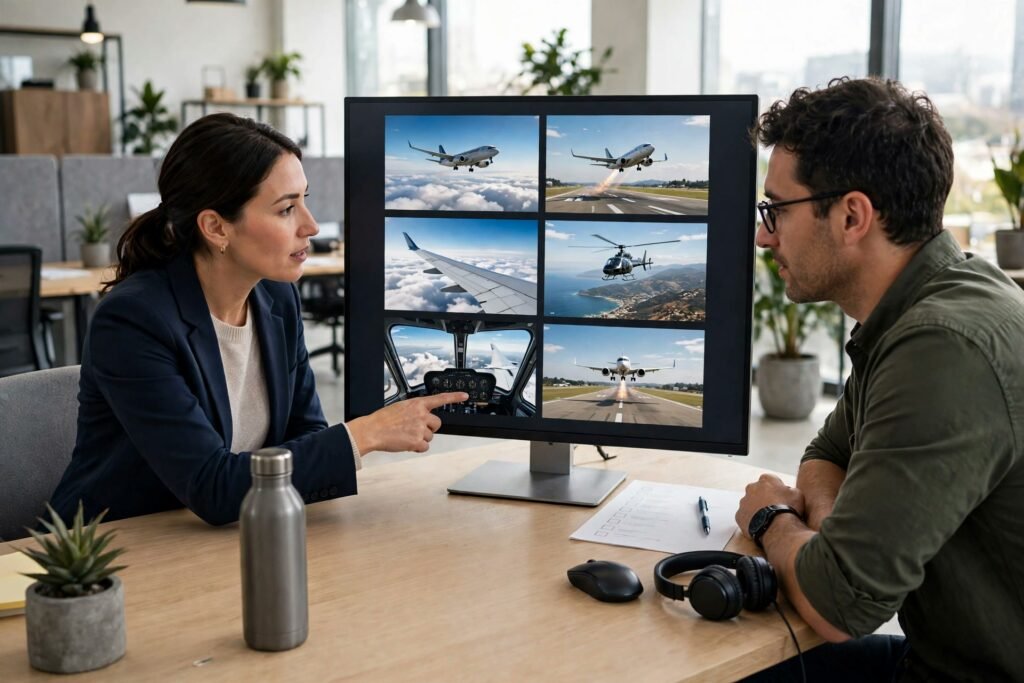
Then comes the visual plan. A script about a flight route needs a moving map that follows the actual route, not a generic arrow, and a script about an aircraft needs diagrams of the right model, not a lookalike. Licensed stock footage fills the gaps, and it has to be licensed: ripping planespotting clips or cockpit videos off other channels is a copyright strike waiting to happen.
Narration, editing, and thumbnails finish the job. A consistent, calm voice suits technical explainers, a warmer tone suits history stories, and we keep the same voice across a channel. The edit cuts original graphics, maps, and licensed visuals to the narration, with captions and sound kept clean, and each video gets a custom thumbnail that matches the aircraft and the claim in the video.
One honest limit: real flight reviews do not work faceless. You cannot judge cabin comfort, legroom, or service without flying, and pretending otherwise will ring false to anyone who has flown the route. If your heart is set on trip reports, a faceless channel is the wrong tool.
DIY vs a done-for-you service
Doing it yourself is a real option, and for some owners it is the right one. The trade-off is time, not talent: one well-made video a month rarely builds a channel, and aviation research eats hours fast. A done-for-you service buys back that time, but only if the team respects the same accuracy rules you would.
| What to compare | DIY | Done-for-you with Xoomo |
|---|---|---|
| Time per video | Many hours across research, script, voice, maps, edit, and thumbnail | Your time goes to topic approval and feedback |
| Consistency | Hard to hold when life gets busy | Scheduled uploads on a steady rhythm |
| Fact checking | On you, every video | Built into the script step, against official sources |
| Footage rights | Easy to slip up on borrowed clips and audio | Licensed visuals only, no ripped planespotting or cockpit clips |
| Sensitive topics | Easy to cross the line on accident content | Respectful, report-based treatment with clear rules |
| Cost | Low cash cost, high time cost | Package price, with thumbnail, SEO, and management included |
| Best for | Owners who enjoy the craft and have spare hours | Owners who want a channel built steadily without doing production themselves |
What a faceless aviation video service should deliver
Before you pay anyone, ask for the full list. A real service should hand you all of this, every video, without being chased for it.
- Researched script with named sources. Every number and claim traceable to an official or reputable source, with disagreements flagged rather than smoothed over.
- Consistent voiceover. The same voice across the channel, recorded cleanly, at a pace that suits explainers rather than a sales pitch.
- Original maps and flight-path animation. Routes, diagrams, and aircraft graphics drawn for your video, not recycled from another channel.
- Licensed footage and audio. Stock visuals and any ATC or cockpit audio properly licensed or public, with the rights documented.
- Full edit with captions. Clean sound, on-screen text where it helps, and nothing in the edit that distracts from the point.
- Custom thumbnail and SEO. A thumbnail that matches the video, plus a search-friendly title, description, and tags.
- Channel management. Scheduling and ongoing uploads, so a channel keeps a steady rhythm instead of bursts followed by silence. Our faceless YouTube channel management covers exactly this.
- A pre-publish fact check. A final pass on facts, visuals, audio, and thumbnail accuracy before the video goes live.
If a provider cannot show you a script with sources, or cannot say where their footage came from, that is your answer. Our done-for-you faceless YouTube channel service and our guide to hiring a faceless YouTube team lay out the same process.
Xoomo packages and pricing
Packages are priced per batch of long videos, and every package includes thumbnails, SEO, and channel management. Monthly service covers 25 long videos plus 10 Shorts. Each long video is 8 minutes. The per-video figures below are simple division, so you can compare batches fairly.
| Package | Price | Per video |
|---|---|---|
| 5 videos | $390 | $78/video |
| 10 videos | $790 | $79/video |
| 12 videos | $890 | ~$74/video |
| 15 videos | $1,099 | ~$73/video |
| 20 videos | $1,499 | ~$75/video |
| 25 videos | $1,899 | ~$76/video |
See the full breakdown on our packages page, and tell us your niche and angle when you get in touch. A narrow angle, like the history of one aircraft family, usually beats a broad “all aviation” channel, because viewers know exactly what they will get from you.
How to vet an aviation video service
Aviation is a niche where a bad provider does real damage, because one wrong fact can sink a channel’s reputation overnight.
Can you show me a script with its sources? A serious team will show you a sample script where the facts are sourced, not just a finished video. If they cannot, they are probably guessing.
Where does your footage and audio come from? The answer should be licensed stock libraries, original graphics, and properly licensed or public ATC audio. “We find it on YouTube” is a red flag, and so is any provider who cannot name a source.
How do you handle accident content? The answer should mention official investigation reports, respect for victims, and a refusal to speculate or sensationalize. A provider who lights up at crash content and talks about views first is telling you who they are.
Who owns the channel? You should own it, full stop, with full access from day one. Any provider who keeps the login or the channel in their name is a problem you will regret later.
What do you promise? Honest providers promise a process, a schedule, and a standard of accuracy. Anyone promising income, views, or monetization by a set date is selling you a guarantee they cannot keep. We do not make those promises, and any service that does should make you pause.
Frequently asked questions
Do I need to be a pilot to run a faceless aviation channel?
No. Faceless aviation formats like flight explainers, aircraft history, airport operations, and news explainers are built on research, narration, and original graphics, not on flying a plane. You do need a clear angle and accurate sources, and a provider who checks facts against official material, but you do not need a pilot’s license.
Can a faceless channel cover plane crashes?
It can, but only as careful documentary work based on official investigation reports, with no graphic detail, no invented dialogue, and no blame assigned before the investigators speak. If a provider treats accident content as easy views, walk away.
Where does the footage come from?
We use licensed stock footage, original maps and diagrams, and properly licensed or public audio. We never rip planespotting clips or cockpit videos from other channels, because that is a copyright strike waiting to happen.
How long is each video, and what is included?
Each long video is 8 minutes and includes a thumbnail, SEO, and channel management. Monthly service covers 25 long videos plus 10 Shorts.
What does a faceless aviation channel cost with Xoomo?
Packages start at 5 videos for $390 and run to 25 videos for $1,899, with the full range on our packages page. Each batch includes thumbnails, SEO, and channel management.
How do I start?
Reach out through our contact page with your niche and angle, or message us on Fiverr or WhatsApp using the links below. We will confirm the package, the angle, and the posting rhythm before production starts.
Ready to build a faceless aviation channel that viewers can actually trust? Start with a package that fits your schedule, then let the videos do the talking. Message Xoomo YouTube Automation on Fiverr or on WhatsApp, or visit our contact page and tell us about the aviation angle you want to build. Client channel — identity protected under NDA.