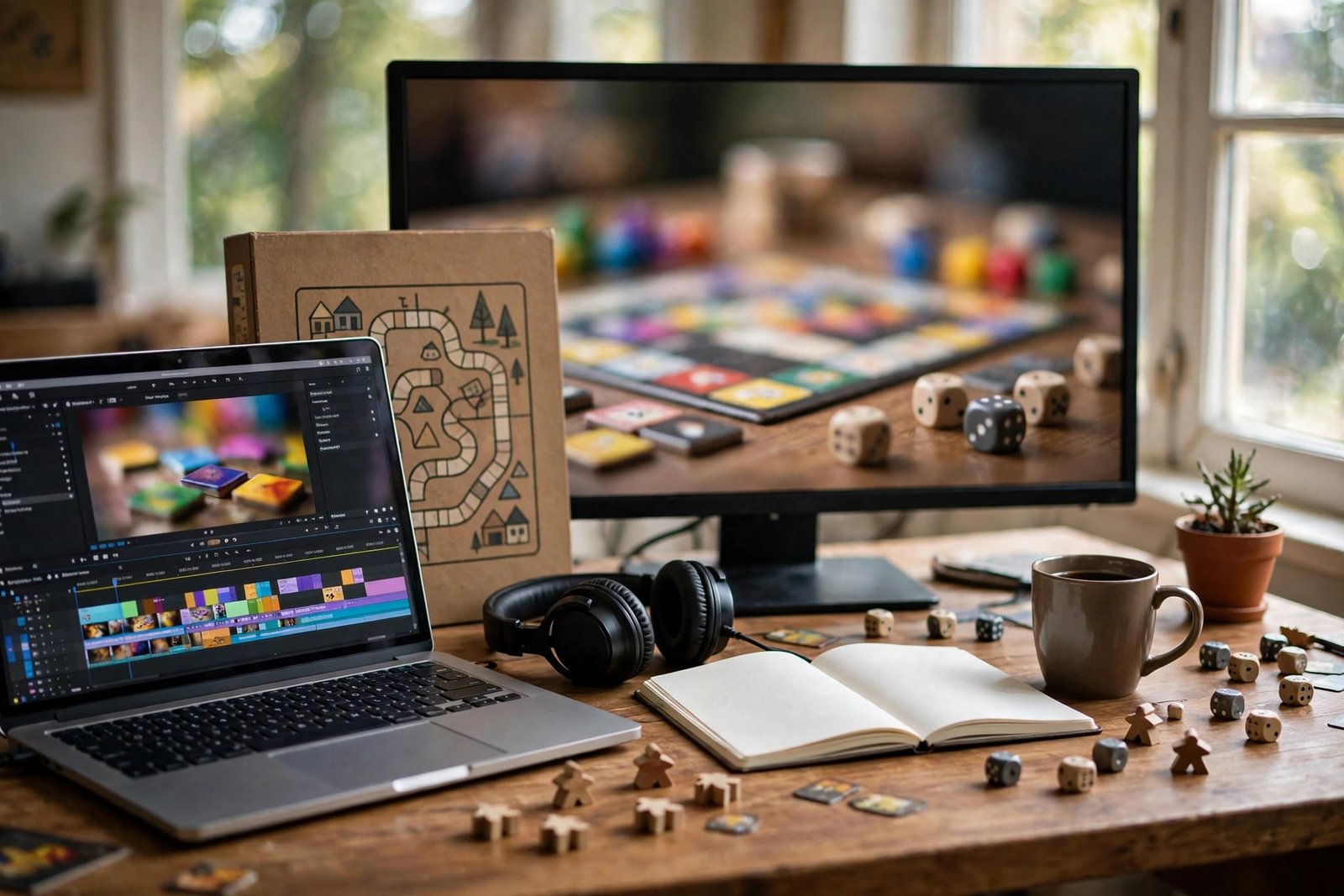
Faceless Board Game Channel Service (2026): The Honest Production & Service Guide
What a faceless board game channel actually is
Board games had a quiet comeback, and YouTube noticed. Shelves that once held Monopoly and a deck of cards now hold strategy epics, co-op adventures, and party games with fan bases that argue about rules online for fun. A faceless board game channel rides that wave without ever putting a host on camera. The table is the star. The board, the cards, the pieces, and a clear voiceover do the talking.
One thing to get straight before we go further: this is not our chess guide. We already published a faceless chess channel guide, and chess deserves its own lane — one game, one board, a deep well of openings and famous matches. This guide covers board games broadly. Reviews of new releases, rules explainers for games you have never played, edited playthroughs, top-10 lists across dozens of titles, and the odd bit of tabletop history. If chess is a single-game channel, a board game channel is the whole shelf.
A faceless board game channel service turns that whole shelf into a publishing system: script, voiceover, tabletop footage, edit, thumbnail, SEO, and channel management. You own the channel. You never sit in front of a camera.

Why board games work so well without a face
Some niches fight the faceless format. Board games welcome it. The viewer came to see the game, not you. An overhead shot of a board mid-game, cards fanned out in a clean row, a close-up of a rulebook page — that is the content. A face in the corner would only shrink the table.
The niche also has a built-in content engine. Publishers release new games constantly, expansions land every season, and Kickstarter campaigns create fresh talking points every week. A channel never runs out of titles to cover, and older games keep working too: a rules explainer for a five-year-old game still pulls viewers because someone just bought it secondhand and needs to learn it tonight.
Board game viewers are patient viewers. A rules video gets watched to the end because the viewer needs the answer, and a review gets watched because the viewer is deciding whether to spend $40 or $60. That intent keeps watch time healthy, and watch time is what YouTube rewards.
One more advantage gets overlooked: board games are family-safe and non-divisive, and advertisers like that. The audience spans teenagers learning party games and retirees working through heavy strategy titles. You are not chasing a narrow demographic that ages out in a year.
The formats that work
Not every board game video idea survives contact with a real audience. The five formats below do, and they map cleanly onto an 8-minute voiceover-plus-visuals production model.
1. Reviews
The cornerstone format. A good review answers four questions: how does it play, what is inside the box, who is it actually for, and is it worth the price? Component quality matters here — viewers want to see the cards, the board, and the pieces up close. A review that reads the box back to the viewer dies fast. A review with a real opinion, a clear verdict, and footage of the game in play earns subscribers.
2. Rules explainers
Complex games scare new buyers, and a clear 8-minute teach removes that fear. The trick is showing the rule, not just reading it. Film the setup, play one example turn with the real components in view, and flag the rule people get wrong. ShortsFast’s recent guides on rules channels make the same point: one rule per episode, the correct edition named on screen, the publisher’s rulebook as the source. Get a rule wrong and the comments will correct you within hours — board gamers notice.
3. Edited playthroughs
A full game rarely fits in 8 minutes, and it should not try. An edited playthrough cuts a 90-minute session to its turning points: the risky trade, the comeback, the move that won it. Keep the table in frame, keep the pacing tight, and cut anything that does not change the outcome. Playthroughs also make strong Shorts material — one clever move, 40 seconds, done.
4. Top-10 and ranking lists
“Top 10 strategy games for two players” and “Best co-op games for beginners” are the shareable backbone of the niche. Lists travel well, they are easy to update each year, and they let a channel cover dozens of games without buying every box. The honest version ranks from real play, not a publisher’s press release. Viewers can tell the difference, and they remember which channels faked it.
5. Board game history and design stories
Some of the best videos in this niche are not about playing at all. They are about how a game came to exist, why a publisher bet everything on one title, or how a classic got its rules — the same documentary instinct behind our faceless documentary channel production guide. CTRmaxxing’s 2026 breakdown found the pattern: the audience comes for nostalgia and stays for the business story. These videos age well. A history piece made today still works in two years.
How a faceless board game video gets made
Behind every clean-looking board game video sits a five-step workflow, and skipping any step shows up in the comments. First, research: pick the game, read the current rulebook, check the edition, and note official corrections. A 2025 edition can change a setup rule, and teaching the old one is the fastest way to lose trust. Second, script: write for the ear, not the eye. Short sentences, one idea per beat, and the verdict stated plainly. Third, voiceover: narration checked for game-term pronunciation — mispronouncing a game’s name never heals in the comments. Fourth, visuals: overhead table footage, component close-ups, and motion graphics for the abstract bits like scoring tracks. Fifth, edit and thumbnail: chapters that match real questions (“Setup”, “Your first turn”, “How the game ends”), and a thumbnail that shows the game, not a generic stock photo.
Our faceless YouTube channel management covers that whole chain — research, script, voice, edit, thumbnail, and SEO — so no step depends on the owner finding a spare evening. And if you want the full picture of how a hands-off channel runs day to day, our done-for-you faceless YouTube channel page walks through it.
DIY vs done-for-you: an honest comparison
Board games are one of the few niches where doing it yourself is genuinely realistic — if you already own the games and know the rules. The table below is the honest version of that trade-off.
| What matters | Do it yourself | Done-for-you service |
|---|---|---|
| Game knowledge needed | You need it — a weak rules read shows up in the comments fast | The team researches the current rulebook and checks every rule |
| Time per video | 6–10 hours: research, filming, voiceover, edit, thumbnail | Your time is the brief and the approval, not the production |
| Equipment | Overhead rig, decent mic, lighting, editing software | Included in the package |
| Publishing consistency | Slips the moment life gets busy | Scheduled output, 25 long videos a month on monthly plans |
| Rules accuracy | On you — one wrong rule can cost you the audience’s trust | Checked against the publisher’s rulebook before recording |
| Cost | Your time plus gear, no cash outlay per video | From $73.27 per video on the 15-video package (see below) |
If you love the games and have the evenings free, DIY is a fine start. If you want the channel to publish while you do something else, that is what a service is for.
Can a board game channel make money?
Yes, and the honest answer has two parts: the ad money is modest, and the other income matters more. Two independent niche rate lists put board game content in roughly the same band — CTRmaxxing reports $5–$10 RPM for board game history, and a 2026 faceless-niche rate list puts board game explainers at $3–$8 RPM. Treat those as reports, not promises. RPM moves with season, audience country, and advertiser demand, and no one can quote your channel a number before it exists.
The real earning story sits outside AdSense. Affiliate links pay when viewers buy the games you review. Publishers and board game stores sponsor channels that review honestly. Kickstarter coverage — previews of upcoming campaigns — is a paid lane that barely exists in other niches. And the back catalog earns for years: a rules video for a popular game keeps getting found by new buyers long after upload day.
Monetization follows YouTube’s standard bar. The YouTube Partner Program asks for 1,000 subscribers with 4,000 valid public watch hours in the last 12 months, or 1,000 subscribers with 10 million valid public Shorts views in the last 90 days. YouTube has announced a change for new channels from February 1, 2027 — 20 million Shorts views or 8,000 watch hours — so confirm the current thresholds in YouTube’s Help Center before you plan around them. One more policy note: in July 2025, YouTube renamed its “repetitious content” monetization policy to “inauthentic content”. Mass-produced, template-made videos with no original perspective were always ineligible; the new name just says it plainly. Original scripts, real rules research, and your own take on each game keep a channel on the right side of that line.
What can go wrong
Three mistakes kill board game channels, and all three are avoidable. First, wrong rules. Teaching a rule from the wrong edition, or from memory instead of the rulebook, is the single fastest way to lose a board game audience. Check the edition, check the publisher’s corrections, and say the edition on screen. Second, borrowed visuals. Game art, box art, and publisher photos belong to someone. Use your own table footage, licensed images, or clearly identified illustrations — never lift another creator’s playthrough or a publisher’s artwork and call it yours. Third, the review trap. A channel that praises every game is a channel nobody trusts. A fair negative review builds more credibility than ten polite ones. Say what you actually think — your audience will respect it, and the publishers worth working with will too.
Xoomo faceless board game channel packages
Every Xoomo YouTube Automation package includes script, voiceover, editing, thumbnail, SEO, and channel management. Each long video runs 8 minutes, and monthly plans cover 25 long videos plus 10 Shorts. See the full breakdown on our packages page, or talk to us through our contact page.
| Package | Price | Per video |
|---|---|---|
| 5 videos | $390 | $78.00 |
| 10 videos | $790 | $79.00 |
| 12 videos | $890 | $74.17 |
| 15 videos | $1,099 | $73.27 |
| 20 videos | $1,499 | $74.95 |
| 25 videos | $1,899 | $75.96 |
One honest note on the math: the 10-video package at $79.00 per video costs slightly more per video than the 5-video package at $78.00. The best per-video value is the 15-video package at $73.27. Pick the package that matches how fast you want to publish, not just the lowest per-video number.
If you want a team rather than a one-off order, our hire a faceless YouTube team page explains how the ongoing setup works. Client channel — identity protected under NDA.

Frequently asked questions
What is a faceless board game channel?
A YouTube channel about board games where no host appears on camera. The videos use overhead table footage, component close-ups, motion graphics, and voiceover to review games, teach rules, and run playthroughs.
How is this different from your faceless chess channel guide?
Our faceless chess channel guide covers one game in depth — openings, famous matches, and board analysis. This guide covers board games broadly: reviews, rules explainers, playthroughs, and top-10 lists across many different games.
Do I need to own the games to run a board game channel?
For reviews and playthroughs, yes — you need the physical game or licensed footage of it. Rules explainers and history videos can be made with illustrations and motion graphics, but the strongest channels film the real components. A done-for-you service sources the game and the footage as part of production.
Can a faceless board game channel get monetized?
Yes. Faceless channels follow the same YouTube Partner Program bar as any channel: 1,000 subscribers plus 4,000 valid public watch hours in 12 months, or 1,000 subscribers plus 10 million valid public Shorts views in 90 days. Original scripts and real rules research keep the channel clear of YouTube’s “inauthentic content” policy.
How much does a faceless board game channel service cost?
Xoomo packages start at $390 for 5 videos ($78.00 per video) and run to $1,899 for 25 videos ($75.96 per video). The best per-video value is the 15-video package at $1,099 ($73.27 per video). Every package includes script, voiceover, editing, thumbnail, SEO, and channel management.
What videos should a new board game channel start with?
Start with three: one rules explainer for a popular game people search for, one honest review of a new release, and one top-10 list. That mix tests three different audiences at once and tells you fast which format your viewers want more of.
Start your board game channel
Board games are a rare niche: evergreen demand, a friendly audience, honest formats that fit an 8-minute video, and income that does not depend on AdSense alone. The hard part is not the idea. It is publishing week after week with the rules right and the table looking good. That is the part Xoomo YouTube Automation takes off your plate.